|
|
 |
Last Update : Today : |
|
|


|
|
|
|
|
|
Last Update : Today : |
|
|
|
|
|
| Although Skoda's reputation as a rally survivor kept the Czech road
car's reputation somewhat intact through the 1980s, it wasn't until
the mid 1990s that Skoda emerged as a real World Rally Championship
force to be reckoned with. Previously, it had been happy to fight for
class victories with cars such as the rear-engined 130LR and the 1994
Formula 2-title-winning Favorit, before developing the 1600cc Felicia
kit car in 1996, which hounded SEAT's Ibiza in the F2 title chase and
finished third on Rally GB at the hands of Stig Blomqvist.
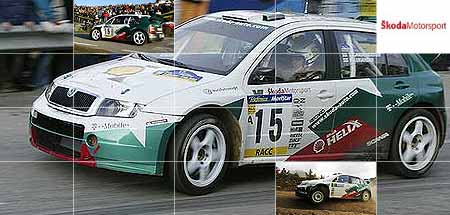
In 1997 a kit car version of the Octavia was built, but it didn't make appear until Finland and then appeared only twice, retiring both times. Czech stalwart Pavel Sibera and Emil Triner had to make do with the 1600cc Felicia, taking a couple of second places in the F2 class in Sibera's hands and winning in Monte Carlo courtesy of Triner. Although SEAT and Skoda were now both part of the Volkswagen-Audi Group, development was started on the Octavia WRC in 1998 to take on SEAT's Cordoba in the WRC in 1999. The Octavia WRC's debut was a disaster for Skoda, however. Both its cars failed to reach the end of the first stage in Monte Carlo and, although the car showed sporadic promise, it had terrible reliability, retiring on most of its seven outings. Armin Schwarz managed just one 12th place finish, but Bruno Thiry showed the potential of Skoda's new charger with a superb fourth place on the end-of-season Rally GB. Schwarz continued to impress in 2000, claiming Skoda's first ever fastest stage time in Catalunya. In 2001, the German finished fourth in Monte Carlo and took Skoda's first podium, with third place on the notoriously tough Safari rally, but a lack of power was hampering the car, which now appeared large and cumbersome in comparison to smaller rivals such as the compact Peugeot 206. The 2002 season was made by the double exclusion of Peugeot's Marcus Gronholm and Richard Burns in Argentina, which handed Skoda five of its nine points for the season. It was clear, though, that a smaller car was needed. As a result, 2003 was a season of two halves for the team. Skoda started the year with the Octavia, whilst it developed the Fabia WRC for introduction on the OMV ADAC Rallye Deutschland. The new car was a big leap forward, but could only manage two 11th place finishes and wasn't enough to keep new signing Didier Auriol on the books for 2004, a season in which the Czech team opted to run in limited events to develop the car for a full-time return in 2005. The Fabia has shown increasing promise, however, and could be a podium contender this year.
|
TEAM PRINCIPAL:
Martin Muehlmeier
DRIVERS: Armin Schwarz - Janne Tuohino (Gravel) -Jani Paasonen (Gravel) Alex Bengue (Asphalt) Mattias Ekstrom (Third car) Jan Kopecky (Third car) CAR: Fabia WRC
BASED:
Miada Boleslav, Czech Republic
ESTABLISHED: 1969 FIRST WRC WIN: n/a TEAM HIGHLIGHTS: 2004: Skoda has a limited programme of events to develop the Fabia WRC, with best finish of sixth in Finland for Jani Paasonen 2003: Toni Gardemeister finishes fifth in New Zealand with the Octavia WRC. The Fabia WRC is introduced for the second half of the year 2002: Toni Gardemeister and Kenneth Erikkson finish fifth and sixth in Argentina in the Octavia, while Roman Kresta comes seventh in the Safari 2001: Skoda leads a WRC event for the first time and takes first podium, courtesy of third for Armin Schwarz in the Safari. He also finishes fourth in Monaco 2000: Skoda sets first stage-topping time in Catalunya in limited programme 1999: Octavia WRC makes its debut and is fourth on Rally GB thanks to Bruno Thiry 1998: Development work starts on Octavia WRC 1997: Octavia F2 car makes its WRC debut in Finland, but struggles for reliability 1996: 1600cc Felicia F2 car finished third on non-championship Rally GB 1994: 1300cc Favorit wins FIA Formula 2 class title |